

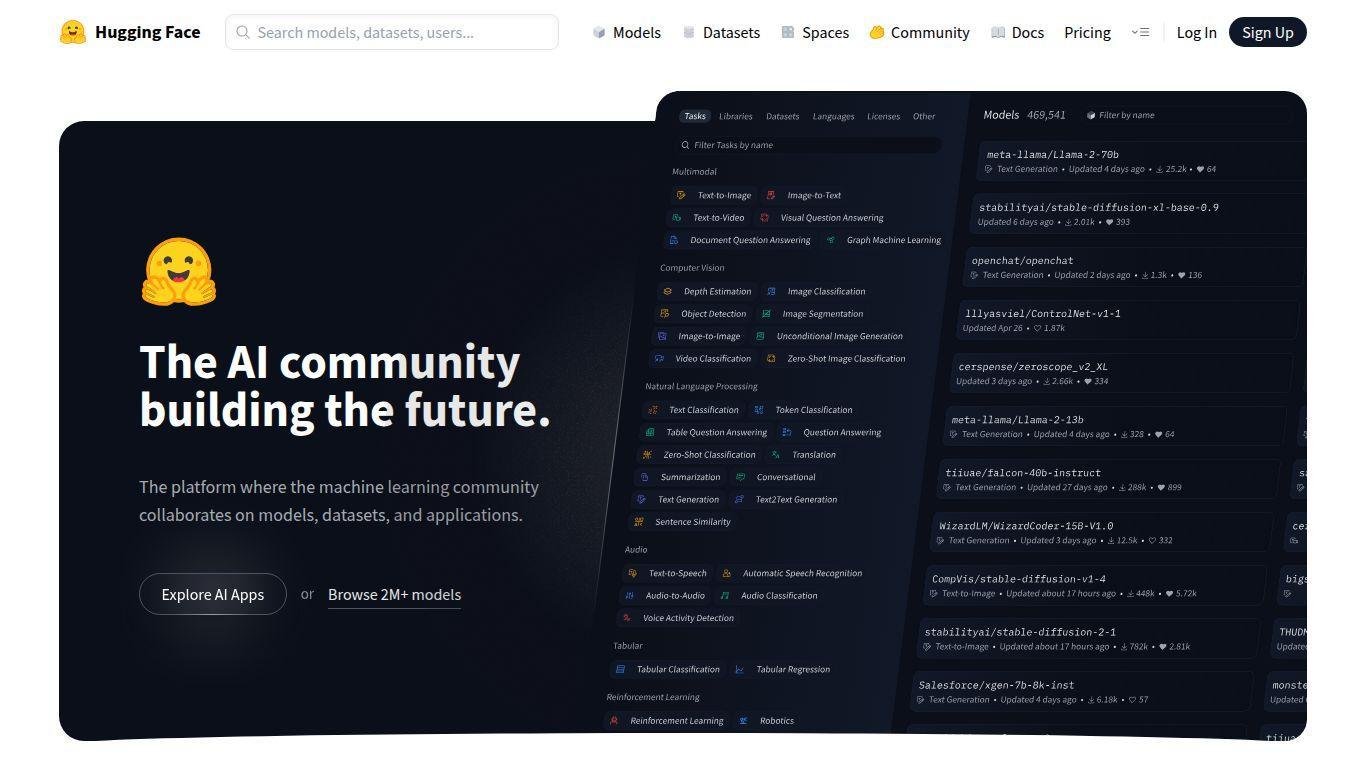
• Hugging Face is an open-source platform and company.
• The focus is on advancing machine learning and artificial intelligence.
• It facilitates collaboration through shared models, datasets, and applications.
• The Hub serves as a resource for developers, researchers, and enterprises.
• Users can browse, upload, and deploy models and demos for various tasks, including NLP, vision, and audio.
A model hub hosting millions of pre-trained models across modalities.
A datasets repository enabling users to explore and share data for ML workflows.
Libraries such as “Transformers” for easy-use of state-of-the-art model architectures.
Deployment and inference support allowing integration of models into applications and production systems.
Community-driven ecosystem and collaboration tools to foster research and shared innovation.
Open governance and ethical focus to support responsible AI usage.
Libraries for dataset processing, model evaluation and demo building (e.g., Datasets, Evaluate, Gradio).
“Spaces” — interactive web apps/demos where users can test models and workflows in the browser.
Versioning and governance of models and data (similar to code repositories) enabling transparency and reproducibility.
Freemium access model: many resources are freely accessible, with premium/enterprise features for teams.

What is Hugging Face?
Hugging Face is a platform and company that enables users to share, discover and deploy machine-learning models, datasets and demo applications in an open-source ecosystem.
What kinds of models does it host?
It hosts models across natural language processing, computer vision, audio, multimodal tasks and more — many pre-trained and ready for fine-tuning or deployment.
Who can use Hugging Face?
Developers, data scientists, researchers and enterprises — from hobbyists to large organisations — can benefit from browsing models or using libraries and infrastructure to build or deploy AI.
Can I deploy models into production via Hugging Face?
Yes — the ecosystem supports deployment, inference endpoints, sharing of models and building demos/spaces for real-world usage.
Is access free, or paid?
Many resources are freely available; the company also offers premium/enterprise features (e.g., private repositories, enterprise support) to teams needing more capabilities.