

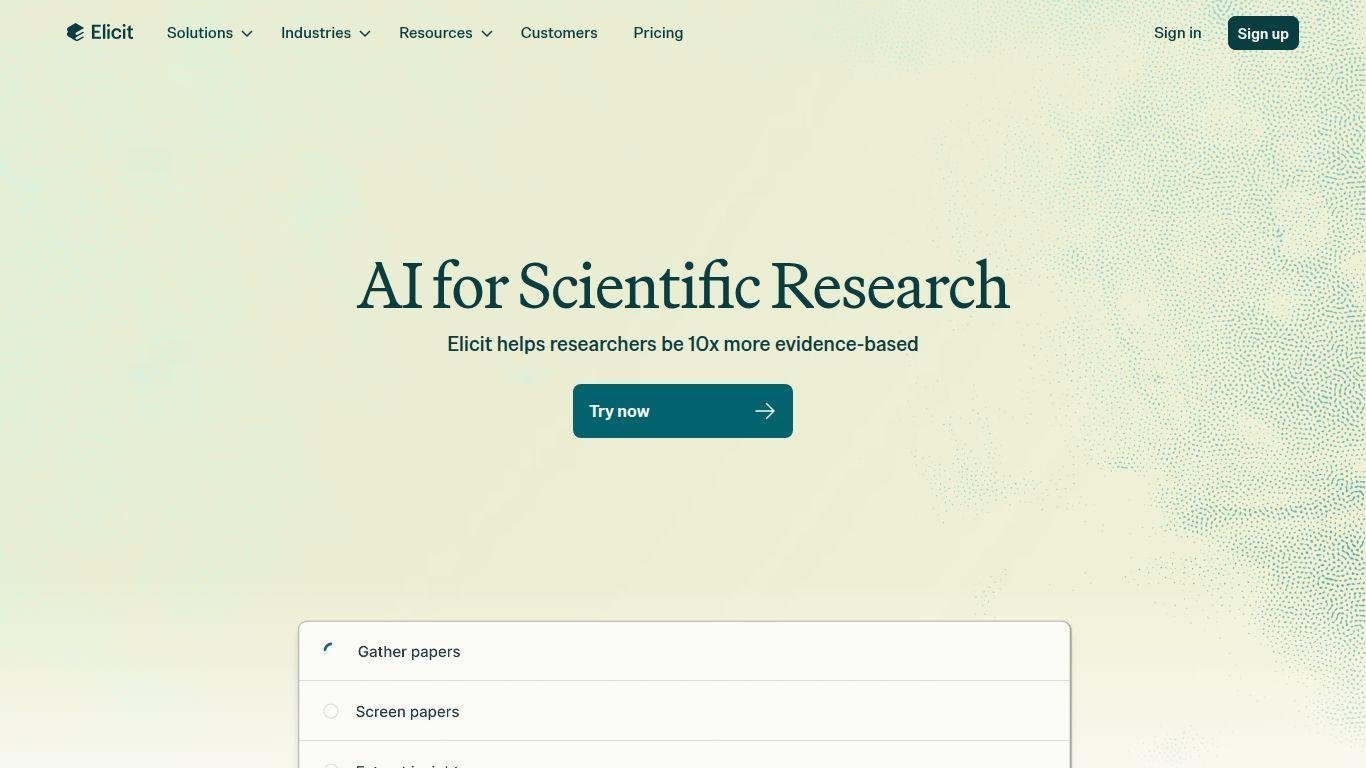
• Elicit is an AI-driven research assistant for scholars, R&D professionals, and systematic reviewers.
• It utilizes a database of over 125 million academic papers and clinical trials.
• Users can ask natural-language research questions and perform semantic searches.
• The platform extracts structured information from relevant literature automatically.
• Supports workflows from exploratory searches to full systematic reviews.
• Allows uploading of PDFs, defining custom extraction fields, and synthesizing findings across studies.
• Facilitates adding custom columns and filters with export options for results.
• Emphasizes transparency and verifiable evidence by linking to original papers.
• Integrates with citation managers and collaborative team workspaces.
• Aims to accelerate the research cycle while maintaining scientific rigor.
Semantic search across a large corpus of academic papers and clinical trials enabling relevant results without perfect keyword matches
Upload and auto-extract data from PDF documents of research papers turning unstructured text into structured tables
Pre-defined and custom extraction fields (e.g., population, intervention, outcome) so you can tailor your review to your needs
Natural-language chatbot interface that allows you to ask questions about the selected papers and receive summaries with citations
Star/bookmark and export functionality (e.g., CSV, RIS, BIB) to integrate with reference managers and workflows
Workflow support for literature reviews and systematic reviews including screening, extraction, and synthesis of findings
Real-time filtering, column management and iterative query refinement so you can refine your search and extraction dynamically
Collaboration features — team workspaces, shared notebooks, usage tracking and live editing for multi-user research projects
High accuracy extraction (reported as 99.4% in one case study) when retrieving data from large numbers of papers
Transparent sourcing — emphasises “real papers only” (i.e., does not fabricate studies) and supports numerous domains (academia, industry, policy, medical affairs)

How does Elicit determine which papers are most relevant to my question?
Elicit uses semantic search over its indexed research corpus, meaning that rather than relying purely on exact keyword matching it understands the meaning of your query and retrieves papers based on thematic relevance. It then presents summaries and allows you to refine results, filter by fields like study type, year, citation count or upload status.
Is Elicit free to use?
Yes — there is a free “Basic” tier which allows unlimited search across its corpus, unlimited summaries of a few papers at once and limited extraction capabilities. Paid tiers (“Plus”, “Pro”, “Team”, “Enterprise”) unlock more advanced extraction volumes, columns, collaboration features and export options.
What data sources does Elicit use and how many papers can I search?
Elicit’s search covers over 125 million academic papers and 545,000 clinical trials (as of the latest published data). Its semantic search and extraction draw from these sources.
Does Elicit ever generate or hallucinate research papers?
According to Elicit’s documentation, one of the guiding principles is “real papers only” — it emphasises sourcing actual peer-reviewed literature rather than fabricating content. Nevertheless, users should apply their own academic judgement and verify extracted data when used for publication.
Who is Elicit best suited for and what use-cases does it support?
Elicit is best suited for researchers, academics, industry R&D teams, medical affairs professionals and policy analysts who need to conduct evidence-based literature reviews, systematic reviews, meta-analyses or curate large bodies of research. It supports workflows across academia, pharmaceuticals, government policy, industry innovation and clinical trial design.