

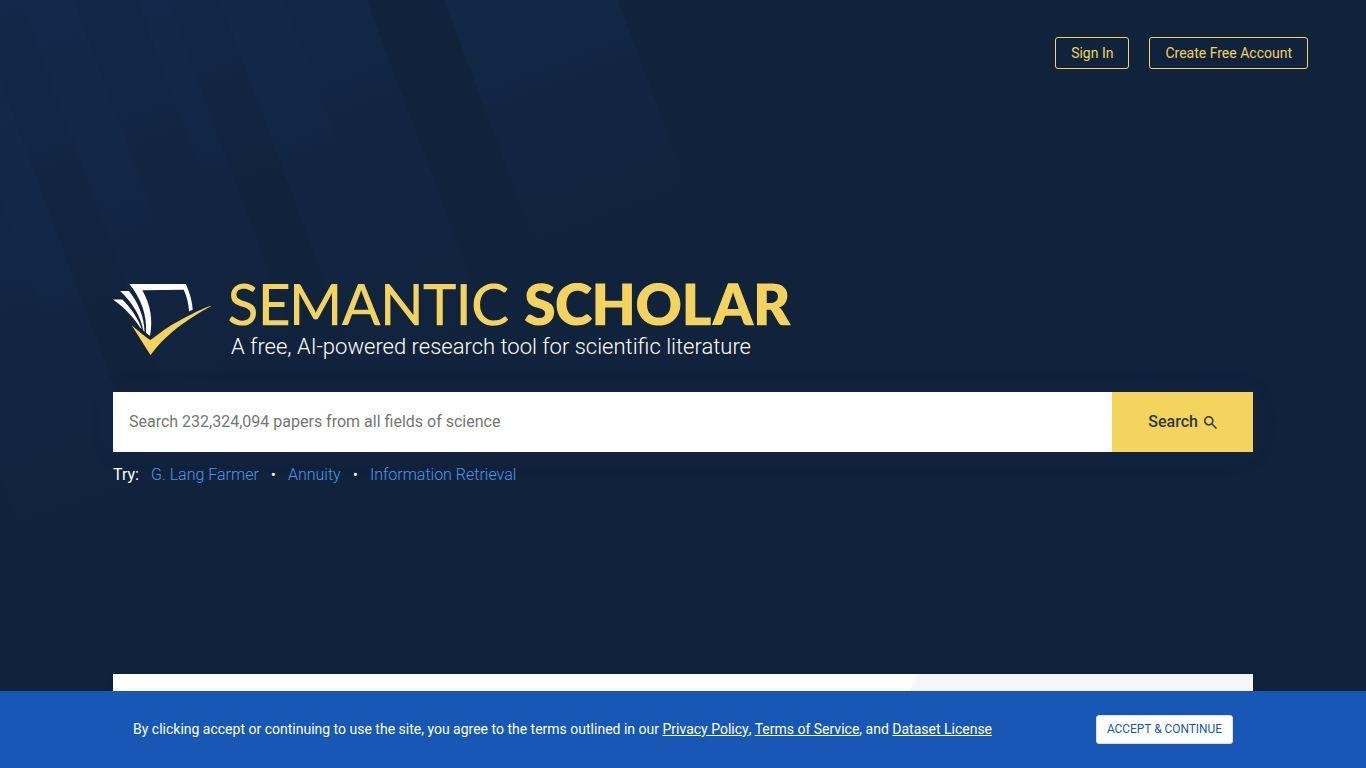
• Semantic Scholar is a free, AI-driven research platform by the Allen Institute for AI (Ai2).
• It assists scholars, students, and practitioners in discovering and navigating scientific literature.
• The platform indexes over 200 million academic papers from various sources, including publishers and web crawls.
• Utilizes advanced machine learning and natural language processing for meaning extraction and connection analysis.
• Features include summaries, topic classification, citation graphs, and the "Semantic Reader" for enhanced understanding.
• Provides open datasets and APIs for researchers and developers to create tools and perform meta-analyses.
• Aims to accelerate scientific breakthroughs by enhancing discoverability and equal access to research.
AI-driven semantic search that interprets meaning, not just keywords, to find more relevant research.
Large coverage: over 200 million academic papers in many scientific fields.
Semantic Reader, which adds augmented reading tools like skimming highlights (Goal, Method, Results) to help users extract key ideas quickly.
TLDR summaries for some papers, giving concise, AI-generated summaries to aid fast comprehension.
Citation graphs and related-paper suggestions to see how research connects (references, influential works, etc.).
Personalized features when logged in: creating a library, saving papers, generating research feeds, and setting up alerts for new research.
Open-data / API access: tools like the Semantic Scholar Academic Graph (S2AG), downloadable datasets, and APIs for querying metadata.
Topic classification & fields of study tagging using ML models (assigning up to multiple fields based on title/abstract).
Browser-compatible, responsive design; no need to install app, works on desktop and mobile.
Beta features that expand functionality: “Ask This Paper” (ask specific questions of individual papers), evolving features in reading aids and summarization.

What makes Semantic Scholar different from other academic search engines?
Semantic Scholar uses AI to extract meaning, identify connections across research, & present enhanced tools (summaries, citation graphs, etc.), rather than just listing keyword matches.
Is Semantic Scholar free to use?
Yes. Access to search, many features, and reading papers is free. No subscription is required for general access.
Can I access the data programmatically or download sets of papers or metadata?
Yes. Semantic Scholar provides open datasets and APIs (e.g. S2AG, S2ORC) for academic use, with monthly updates.
Do I need an account, and what do I gain if I create one?
You don’t need an account to search or view many papers. If you do create an account, you can save papers, get alerts, build research feeds, and claim an author page.
What are the limitations of features like summaries, “Ask This Paper”, or augmented reading?
Some features are in beta, only available for certain papers or domains; full text may be missing or behind paywalls; the system may occasionally make errors in summarization or classification.