

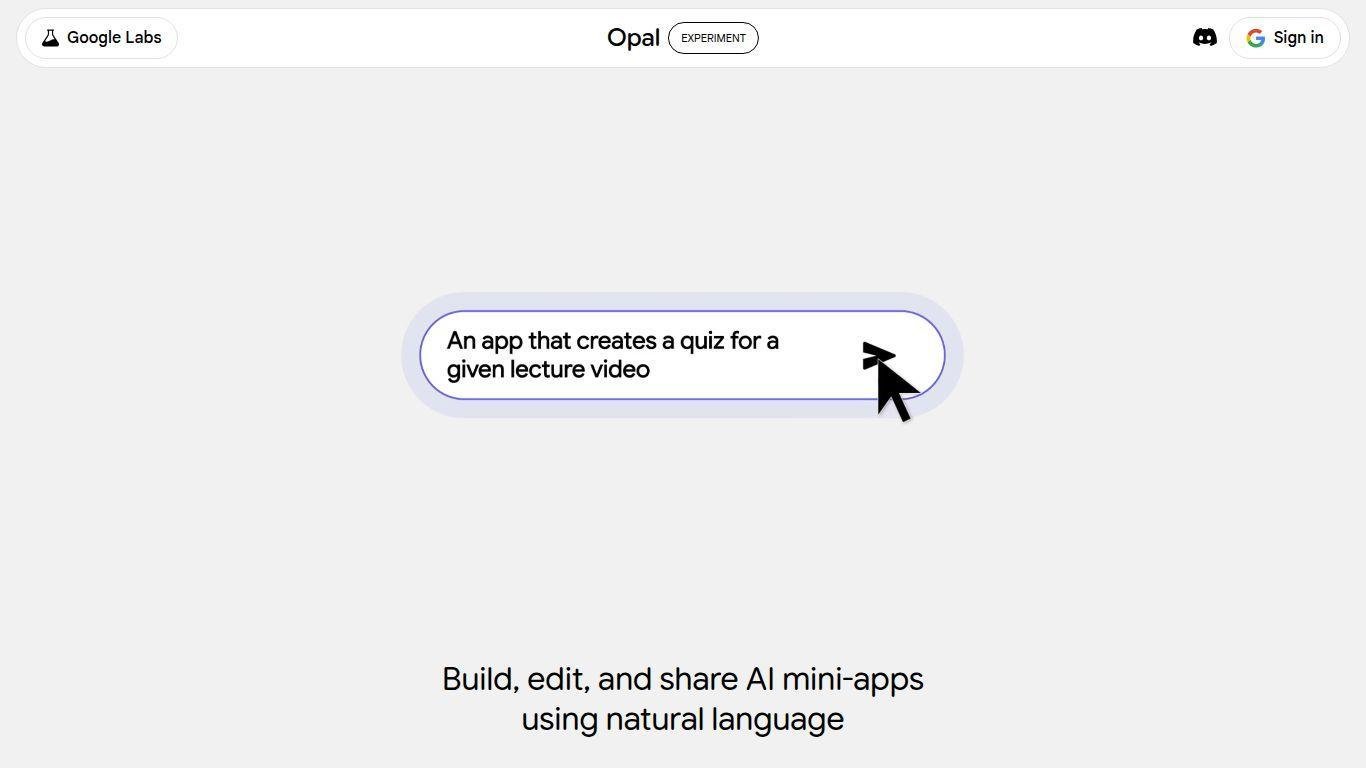
• Opal is a no-code AI platform developed by Google Labs.
• It allows users to create, edit, and share AI mini-applications using natural language and visual workflows.
• Transforms written descriptions into structured workflows linking prompts, AI models, and automation without traditional coding.
• Aims to simplify AI development and promote rapid experimentation.
• Users can describe their desired applications, and Opal generates corresponding workflows.
• The platform supports productivity, prototyping, and creative exploration, enabling quick assembly of complex workflows.
• Offers the option to start from scratch or use a gallery of templates and mini-apps for inspiration.
• Completed apps can be shared instantly and accessed by others using Google accounts.
• Manages hosting and execution, allowing creators to focus on design rather than deployment challenges.
• Represents a shift towards conversational development, where intent description supersedes coding.
Natural language app creation that converts written instructions into functional workflows
Visual workflow editor for refining steps without coding
AI mini-app builder combining prompts, models, and tools
Template gallery for quick starting points and inspiration
Instant publishing and sharing via Google accounts
Conversational editing for modifying app logic dynamically
Automatic hosting and cloud execution infrastructure
Multi-step workflow chaining and automation capabilities
Collaborative sharing and remixing of existing apps
Rapid prototyping environment for AI experimentation and productivity workflows

What is Google Opal?
Opal is an experimental no-code platform from Google Labs that allows users to create AI mini-apps by describing workflows in natural language.
Do I need programming experience to use Opal?
No. The platform translates written instructions into visual workflows, removing the need for traditional coding.
How are apps built in Opal?
Users describe the desired functionality, and Opal generates a workflow that can be refined through visual editing or conversational commands.
Can I share apps created with Opal?
Yes. Completed apps can be shared through links, enabling others to use them with their own Google accounts.
What is Opal mainly used for?
Common uses include rapid prototyping, productivity tools, workflow automation, educational projects, and AI experimentation.