

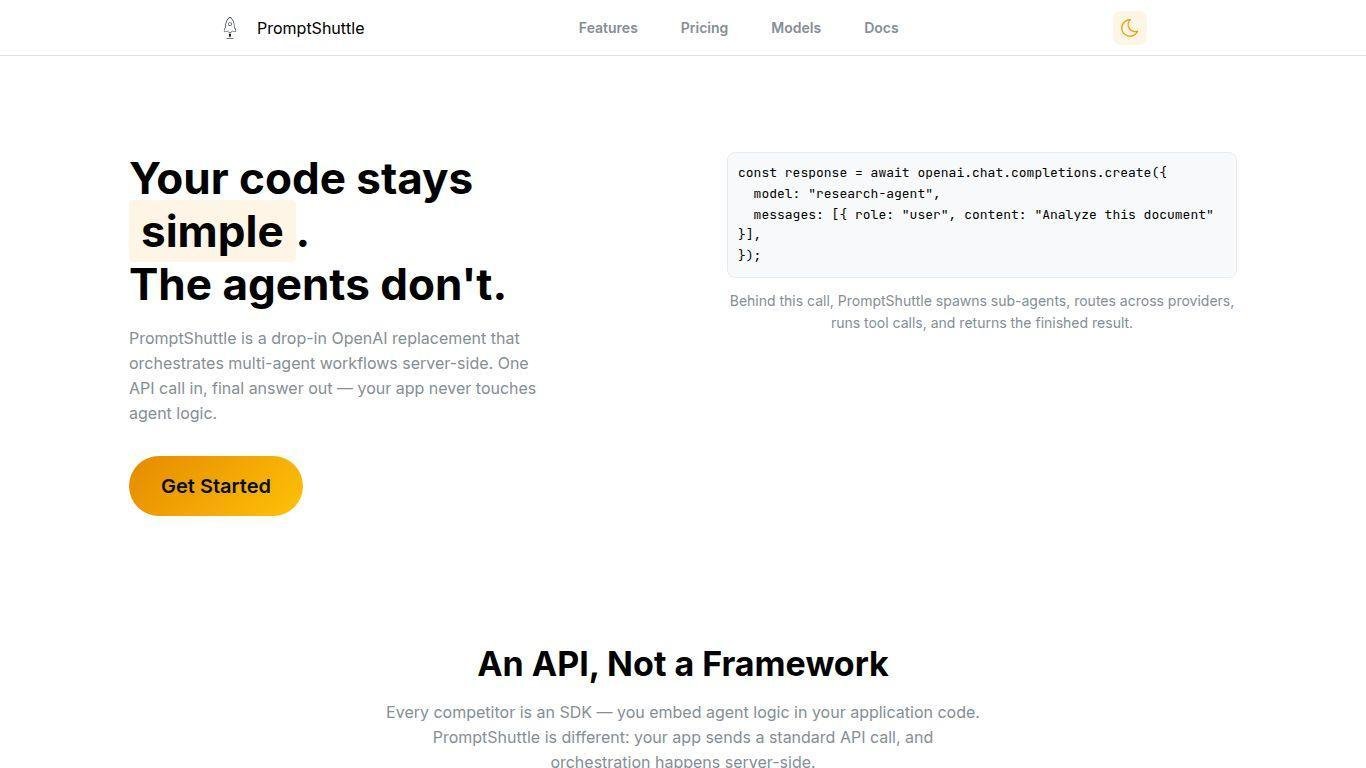
• PromptShuttle is an AI prompt management and deployment platform.
• It simplifies the process of building, testing, organizing, and distributing prompts across AI applications.
• Provides a centralized workspace for storing, versioning, and sharing prompts.
• Enhances collaboration and efficiency for developers and AI practitioners involved in prompt engineering.
• Users can create structured prompt collections and manage revisions.
• Enables quick deployment of optimized prompts with reduced manual configuration.
• Collaboration features support team reviews, reuses, and refinements of prompts.
• Reduces friction in managing prompts at scale and helps standardize prompt engineering practices.
• Accelerates AI-driven development through improved organization and streamlined deployment.
Centralized repository for storing and managing AI prompts
Version control for tracking prompt changes and iterations
Collaborative workspace for team-based prompt development
Reusable prompt templates for consistent outputs
Structured prompt organization with tagging and categorization
Rapid deployment of prompts across AI applications
Documentation support for prompt testing and experimentation
Searchable prompt library for fast retrieval
Workflow-focused interface for iterative development
Scalable solution for individual users and enterprise teams

What is PromptShuttle used for?
PromptShuttle helps users manage, organize, and deploy AI prompts efficiently within collaborative workflows.
Who should use PromptShuttle?
Developers, AI practitioners, product teams, and organizations working extensively with AI prompts can benefit from the platform.
Does PromptShuttle support collaboration?
Yes. It includes collaborative features that allow teams to share, review, and refine prompts together.
Can prompts be reused across projects?
Yes. PromptShuttle enables reusable templates and centralized storage to maintain consistency across different workflows.
How does PromptShuttle improve productivity?
By organizing prompts, tracking versions, and simplifying deployment, it reduces manual work and helps teams focus on optimization and experimentation.